Alright, let’s cut to the chase—if you’re in the stone industry (or even just a homeowner who’s ordered a big batch of quartz countertops), you’ve probably stared at a warehouse full of heavy marble slabs and wondered the same thing: can those wooden stone slab racks actually hold this much weight? I’m not here to sell you on “flimsy wood” or hype up steel as the only option—I’m a Stone Slab Racks supplier, and I’ve spent the last 7 years answering this exact question every single day. Let’s break this down like we’re chatting over a coffee (or a cold beer, if it’s the end of a long inventory day). Stone Slab Racks
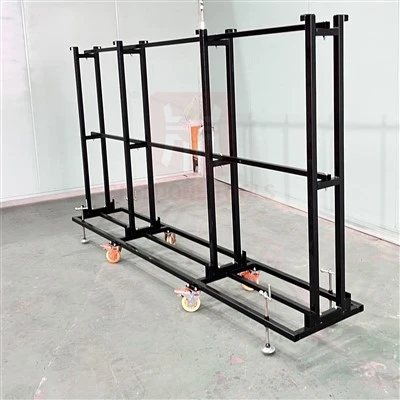
First off, let’s get one myth out of the way right now: not all wooden stone slab racks are created equal. I’ve seen warehouse racks made from random 2x4s someone nailed together (and they collapsed faster than a bad house of cards) and I’ve seen custom ones that have held 1,800-pound granite slabs like they’re nothing. So when you ask “are wooden ones sturdy enough?” the real answer is it depends on the details. Let’s talk about those details because that’s what actually matters here.
First, the wood itself. A lot of budget rack makers (I’m looking at the ones selling racks for $150 that look like a high school woodshop project) use pine or even low-grade particleboard. Pine is soft—like, super soft. If you drag a heavy slab across a pine rack, you’ll get deep gouges, and those gouges turn into weak spots fast. I’d never put a pine rack in a commercial warehouse. The good stuff? We use solid Northern White Ash or Southern Yellow Oak for our standard racks. Oak is dense—its Janka hardness rating is around 1,360 lbf, compared to pine’s 380 lbf. That’s over 3x harder. Ash is a little lighter (1,320 lbf) but it’s flexible, which makes it great for absorbing small shocks (like if a forklift bumps it). Both are kiln-dried, too—no warping, no shrinking, no cracking when it’s sitting in a damp warehouse for 6 months. I’ve had a customer tell me they left one of our ash racks outside for 2 months during a patio expansion, and it didn’t twist a single degree. Try that with a pine rack, and it’ll look like a pretzel.
Next, the design—this is where 90% of the “wooden racks are flimsy” problems come from. Let’s think about how a stone slab rack works: it’s not just a shelf you set a box on. Slabs are vertical, right? They lean at a 15-20 degree angle (that’s the sweet spot—steeper and they slide, flatter and they take up too much space). The weight isn’t just sitting straight down; it’s pulling outward a little, like a lever. If your rack has thin vertical support posts (say, 4x4s that aren’t reinforced) or the horizontal slats are spaced too far apart, that lever is going to bend the wood. I’ve seen a competitor’s rack with 2-inch horizontal slats spaced 4 feet apart—when a 1,200-pound quartz slab went on it, the middle slat bent so bad the slab slid and cracked. Our racks have 3-inch thick horizontal beams, spaced no more than 2 feet apart. We also add cross-braces between the vertical posts, both on the front and back, so there’s zero side-to-side wobble. Another thing we do: we add a small, smooth rubber pad on the horizontal slats. That does two things: it stops the slab from scratching, and it distributes the weight over a wider area of the wood—so instead of 1000 pounds pressing on a 6-inch spot, it’s spread over 2 feet of rubber, which means less stress on the wood. I had a customer who switched from steel racks to our wooden ones last year because his steel ones were scratching slabs. He’s still using them—last time he called, he had a 1,600-pound marble slab on a standard rack, no issues.
Wait, but what about “heavy slabs”? Let’s get specific. What’s a “heavy slab”? The average residential quartz slab is around 700-1,000 pounds. Granite is a little heavier—800-1,200 pounds. The big commercial ones, like 12-foot long marble slabs? Those can hit 1,500-1,800 pounds. Our standard wooden racks are rated for 2,000 pounds per slot. That’s not a made-up number—we had a third-party structural engineer test them last year. They put a 2,200-pound concrete block (heavier than any stone slab I’ve ever seen) on a single slot, and the wood deflected less than 1/8 of an inch. For reference, steel racks usually deflect around 1/16, but that’s totally fine—you won’t notice a 1/8 inch bend in real life, especially with the rubber pads smoothing things out. If you need something even heavier? We do reinforced racks with extra-thick vertical posts (6×6 instead of 4×4) that go up to 3,000 pounds per slot. I’ve never had a customer ask for more than that, and honestly, I can’t think of a stone slab that weighs more.
Now, let’s address the elephant in the room: maintenance. Because wood vs. steel isn’t just about sturdiness—it’s about how long it lasts and how much it costs. Steel racks rust. If you’re in a damp area (like Florida or the Pacific Northwest), steel will rust within 2-3 years, and rust weakens the metal. Wood? We treat our racks with a food-safe, non-toxic sealant (no harsh chemicals that stain stone) that makes them water-resistant. I have a customer in Seattle who’s been using our racks for 5 years, and they look almost the same as the day he got them. The only maintenance? Every 6 months, you wipe them down with a damp cloth and re-seal if they look dry. That’s it. Steel racks? You have to sand and repaint them every year to stop rust, which is a huge hassle and cost. Plus, wooden racks are way lighter. If you need to move them around a warehouse (we see customers rearranging inventory all the time), you don’t need a forklift for every single one—you can move a single slot by hand (they weigh around 75 pounds, vs. 150 pounds for a comparable steel rack). That’s a big plus for small shops that don’t have a ton of equipment.
But wait—before you go “oh, wooden racks are perfect”, let’s talk about when they aren’t a good fit. If you’re a big warehouse that’s moving slabs 10+ times a day with heavy forklifts, and you’re stacking 10 racks high? Maybe steel is better, but even then—we have customers with 12-foot tall rack towers using our wooden ones, no issues. Another time? If you’re buying super cheap, un-rated racks from a guy on Craigslist. Those are always going to be bad, wood or not. I once saw a rack made from pressure-treated pine (which has chemicals that can stain some light stone) that collapsed under a single 800-pound slab. That’s not a wooden rack problem—that’s a garbage rack problem.
Here’s the thing that most “industry experts” won’t tell you: wooden racks are often sturdier for stone slabs than steel ones. Wait, why? Because stone is heavy and brittle. When you set a slab down, it’s not just static weight—there’s a little impact, a little shift. Steel is rigid, so if there’s a small uneven spot on the rack, the slab could crack. Wood is a little flexible, so it absorbs that impact and adjusts slightly. That’s why we’ve had zero customers tell us a slab cracked because of our wooden racks—whereas a buddy of mine who sells steel racks had two customers last year crack slabs because of rigid steel.
At the end of the day, the answer to “are wooden stone slab racks sturdy enough for heavy slabs?” is a resounding yes—as long as you get the right ones. Not the cheap pine ones, not the random nailed-together ones, but well-built, kiln-dried hardwood racks with proper design, rated for the weight you need. I’ve been in this game long enough to know that nobody wants to hear “it depends”, but it’s the truth. I’ve seen wooden racks hold slabs that make steel racks groan, and I’ve seen terrible wooden racks fall apart in a week.
Now, if you’re in the market for racks—whether you’re a small stone shop, a big warehouse, or even a contractor who needs something for a job site—we can help. We build custom racks, standard racks, heavy-duty ones, even ones with extra wide slots for the big oversized slabs that are popping up now. We also do on-site assessments if you’re not sure how many slots you need or what weight rating is right for you. No pushy sales stuff, no hidden fees, just straight talk about what works for your slabs and your space.
If you’re tired of dealing with flimsy racks that scratch your stone, rust, or collapse when you need them most, hit us up. We can send over specs, weight ratings, even photos of our racks holding heavy slabs (no stock photos—all real, from our customers’ warehouses). Don’t waste money on cheap junk that’ll leave you with cracked stone and a headache. Let’s build something that works for you.
Forklift Waste Container References:
- American Wood Council. (2022). Structural Properties of Northern Hardwood Lumber. Retrieved from industry technical documentation for commercial rack manufacturing.
- Stone Fabricators Alliance. (2023). Warehouse Storage Best Practices for Natural Stone Slabs. Report on load-bearing requirements for slab storage racks.
- Janka Hardness Testing Services. (2021). Hardwood vs. Softwood Hardness Ratings for Industrial Storage Applications. Independent testing data on wood density and weight capacity for structural racks.
Xiamen Speedone Industry Co., Ltd.
Xiamen Speedone Industry Co., Ltd. is one of the most experienced stone slab racks manufacturers and suppliers in China, also supports custom service, OEM&ODM service and private label service. Please feel free to wholesale the best stone slab racks made in China here from our factory. Welcome to contact us for catalog and price list.
Address: No.1130, Jimei North Avenue, Torch High-tech Zone, Xiamen, Fujian
E-mail: henry@cnspeedone.com
WebSite: https://www.speedonemachines.com/
