What’s up everyone, if you’re in the mineral processing or material testing game, you know a shaking table is kind of a make-or-break piece of gear—right? I’ve been supplying shaking tables for over 10 years now, and one of the most common questions I get from new operators (even some veteran guys who’ve been using them for ages) is how to nail the slope adjustment. Mess that up, and you’re just wasting material, time, and money. No cap, I’ve seen guys run tables for weeks with a wonky slope, wondering why their concentrate grades are trash. Today, I’m breaking this down like we’re shooting the breeze over coffee, no jargon that makes your eyes cross. Shaking Table

First off, let’s keep it real: the slope isn’t just a random dial you twist. It’s the angle that makes the mineral slurry (or whatever material you’re processing) move down the table while the riffles catch the heavy stuff, and the light stuff gets swept off. Too steep, and heavy minerals will race right past the riffles—you lose gold, tin, whatever you’re chasing. Too flat, and nothing moves at all; you end up with a stagnant mess on the table deck. I see this happen all the time with new customers who think “lower slope = more control” but end up with zero throughput.
Let’s start with the basics of your typical shaking table setup. Most standard tables have two adjustment points, right? The head end (where the material feeds in) and the tail end (where the waste drops off). That’s where you tweak the slope. But wait—before you even touch a wrench, you need to know what you’re working with. What material are you processing? Particle size? Feed rate? Those are game-changers. For example, fine gold (like placer gold that’s -200 mesh) needs a flatter slope, like 1 to 3 degrees, because those tiny particles don’t have enough weight to hold onto the riffles if the slope is too steep. Coarse material, like 10 mesh ore, needs a steeper slope, more like 3 to 5 degrees, so the heavy coarse stuff doesn’t get stuck. I always tell customers to run a small test batch first before adjusting—don’t dump a whole bucket of ore into a table that’s set wrong. It’s way easier to tweak 10 pounds than 1000, trust me.
Now, step-by-step: let’s get practical. First, shut off the feed and let the table run empty for a few minutes. You don’t want to be adjusting while slurry is flying everywhere—this is safety 101, people. Once it’s running dry, grab your angle gauge (you can get a cheap digital one at any hardware store, no need for a fancy lab tool) and measure the current slope. Most tables have a reference mark, but those are just a rough guide—always measure actual angle. Let’s say it’s set to 2 degrees, and you’re running coarse material. You want to raise the tail end, right? Because raising the tail makes the slope steeper, and lowering it makes it flatter. Wait, no—let me double check that for you. The head is the higher end, feed goes in there, material moves towards the tail. So if you lower the tail, the difference between head and tail is smaller = flatter slope. If you raise the tail, bigger difference = steeper. Yeah, that’s right. So for coarse material, you’re raising the tail, usually a quarter turn at a time. Don’t crank it all the way—small adjustments.
Wait, but a lot of modern shaking tables have hydraulic slope adjustment, right? Old-school ones are manual screws, new ones have a lever you push. No matter which you have, the rule is same: make tiny tweaks, wait 5 minutes, then check the product. Why wait? Because the table has to stabilize—when you adjust the slope, the whole deck shifts, and the riffle flow changes a bit. I’ve had customers adjust, then run back in 30 seconds later and wonder why it’s not working. Patience is key here.
Now, how do you know if the slope is right? That’s the trick—you can measure all day, but the real test is what comes off the concentrate and tails. Let’s describe the ideal run: you should see three distinct streams coming off the end of the table. Concentrate (the good stuff) is the narrow, heaviest stream closest to the riffles, middling is the middle wider stream, and tails (waste) is the full, light stream on the far edge. If your middling is too thick, and the concentrate is mixed with a bunch of light material? That slope is too flat. If the concentrate is getting swept into the tails, and nothing’s sticking to the riffles? Slope is too steep. I once had a customer who kept losing 20% of his gold because he had the slope 1.5 degrees too high—fixed that, and he doubled his yield. That’s the kind of win I live for with my tables.
Common mistakes I see all the time: first, ignoring material type. If you’re switching between coarse and fine ore, you’ve gotta adjust the slope. A lot of guys leave their table set for coarse, then run fine stuff and wonder why nothing separates. Second, not calibrating the table over time. Those adjustment screws loosen up from vibration, right? So every 100 hours of run time, you should check the slope. I’ve seen tables that were 2 degrees off because the screw worked loose—huge difference. Third, over-adjusting. You don’t need to turn the screw a full revolution to make a change. A quarter turn is enough, usually. I had a guy once crank the tail end all the way up because his concentrate wasn’t coming out, and the table actually tilted so much the slurry was running straight off the head—total waste of an hour of time.
Wait, what about variable-speed shaking tables? Some newer ones let you adjust the stroke rate too, but that’s separate from slope. Slope and stroke work together—if you have a steeper slope, you might want a slightly faster stroke to keep the material moving. But that’s a whole other topic, let’s stick to slope today. Oh, and for wet vs dry shaking tables? Yeah, wet ones (most common for mineral processing) use water to carry the slurry, so slope should be a touch flatter than dry ones. Dry tables are for things like separating plastic particles, so they need a steeper slope because there’s no water to move the material.
Let’s do a quick example to make it real. Suppose you’re processing gold ore that’s 10 to 100 mesh. Feed rate is 5 tons per hour. You start with a 3 degree slope. After 10 minutes, you check the streams: concentrate is mixed with a lot of light quartz, middling is almost non-existent, tails have some coarse gold. That means slope is too flat. You lower the tail a quarter turn (so slope becomes ~3.5 degrees). Wait 5 minutes, check again. Now concentrate is clean, middling is a nice thin stream, tails are all waste. Perfect. If instead, the concentrate was getting swept into the tails, you’d raise the tail a quarter turn to lower the slope by 0.5 degrees. Easy peasy, when you know what to look for.
Now, let’s talk about maintenance tips related to slope. If your adjustment mechanism is sticky (common in dusty environments, which most mines are), spray it with a light lubricant every month. Don’t use heavy grease, that’ll just attract more dust and make it harder to adjust. Also, make sure the leveling legs of the table are set right—wait, hold on! I almost forgot this. The slope adjustment is relative to the table being level side to side. If your table is tilted left or right, the side-to-side tilt will mess with the material flow, even if the head-to-tail slope is perfect. That’s another super common mistake. Before you adjust the slope, make sure the table is level on all axes. Use a spirit level—place it on the deck, side to side, front to back. Adjust the leveling feet until it’s dead level. Then tweak the head-to-tail slope. I can’t tell you how many customers have called me saying their table is broken, only to find out it was sitting on uneven ground, so the side tilt was off. That’s on them, but I always remind folks to check level first.
Wait, another thing: feed density. If your slurry is too thick (too much solids, not enough water), it’ll move slower, so you need a flatter slope. If it’s too thin, moves too fast, need a steeper slope. Slope, feed density, and feed rate all work together—they’re not separate variables. So if you change your feed rate, you might need to adjust slope too. For example, if you go from 5 tons per hour to 8 tons per hour, material is moving faster, so you need a steeper slope to keep the heavy stuff from getting left behind.
Let’s wrap this up. The key takeaways are: know your material, adjust in tiny increments, wait for the table to stabilize, check the product streams, keep your table level, and calibrate the adjustment mechanism regularly. I’ve supplied thousands of shaking tables over the years, and 90% of the issues customers have with separation are related to slope being off. It’s not rocket science, but it’s not something you can guess at either.
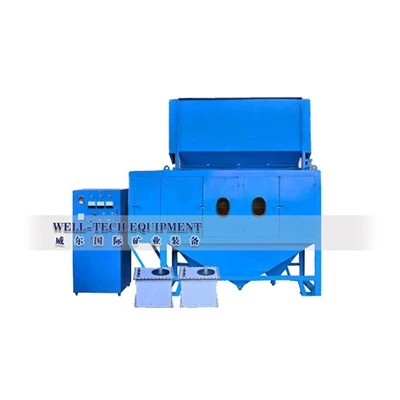
If you’re still struggling to get the slope right, or you need a shaking table that’s built with easy, reliable slope adjustment (no sticky screws, hydraulic options for less manual work), hit me up to chat through your setup. We’ve got tables for all kinds of materials—minerals, recycling, lab testing, whatever you’re working on. No one-size-fits-all here, so we can work together to get your slope dialed in and your yield up.
Rotary Scrubber References:
- Mineral Processing Equipment: Shaking Table Operation and Maintenance, 2022
- American Institute of Mining, Metallurgical, and Petroleum Engineers (AIME), Shaking Table Separation Guide, 2021
- Industrial Shake Table Slope Adjustment Best Practices, International Process Machinery Association, 2020
Jiangxi Well-tech International Mining Equipment Co., Ltd.
Jiangxi Well-tech International Mining Equipment Co., Ltd. is one of the most professional shaking table manufacturers and suppliers in China, featured by quality products and good service. Please rest assured to wholesale customized shaking table at competitive price from our factory.
Address: Guzhang Industrial Park of Shicheng County, Ganzhou City, Jiangxi Province, China
E-mail: mily@benefication.com
WebSite: https://www.cn-welltech.com/
