If you’ve ever shopped for wire cable flammability testers, you’ve probably wondered: same tester, different cable sizes—does that work? I get it, I’m the guy who gets a dozen of these exact questions a week from electricians, factory safety managers, and R&D nerds tinkering with new wire formulations. I run a small, family-run supplier of these testers, so my answer isn’t just textbook stuff—it’s the stuff I’ve learned fixing clients’ messy, wrong-test situations when they grabbed the wrong tester for their job. Let’s break this down, no stuffy lab jargon, just real-world truth. Wire Cable Flammability Tester
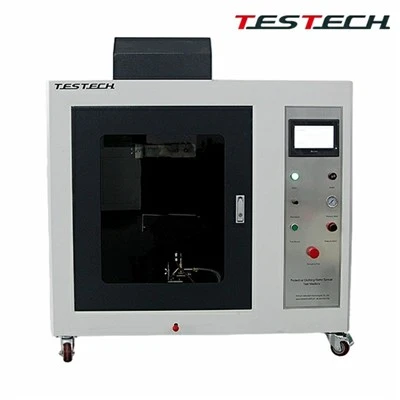
First, let’s define what a wire cable flammability tester actually does, because half the confusion comes from people mixing up “any fire test” with the specific ones we build. These testers are designed to mimic real worst-case scenarios: like if a frayed indoor wire sparks and catches, or a big underground industrial cable melts and ignites surrounding insulation. Most of the standard tests (think UL 1581, IEC 60332-1, the two big ones everyone uses) work by exposing a section of cable to a controlled, calibrated flame for a set amount of time, then measuring if the flame spreads past a certain mark on the wire. The core goal isn’t to test “big vs small”—it’s to test how well the cable’s insulation and jacketing resist that specific flame. That’s the foundation, right there.
Now, the big question: can these testers handle different cross-sectional areas? Short answer: yes, but only if the tester is built right, and you’re not trying to push it beyond its design limits. I’ve seen people try to cram a 1-inch thick industrial power cable into a tester meant for 12-gauge house wire, and that’s a disaster. The flame won’t hit the core section evenly, the measurement marks will be off, and you’ll get a false pass or fail that’s useless. But build the tester to be adjustable, and it works for everything from tiny 24-gauge speaker wire up to 2/0 gauge welding cable, no problem.
Let me walk through why cross-sectional area matters for these tests, beyond just “fitting the cable.” Cross-sectional area (that’s the width of the cable’s insulation and jacketing, for anyone not deep in wire specs) affects how much fuel the cable has when it burns. A tiny 20-gauge wire has a super thin insulation layer—so if a tester’s flame setup is calibrated for thin wires, it’ll torch the whole thing in 10 seconds, which isn’t realistic. A thick, 500-kcmil underground cable has a massive layer of cross-linked polyethylene (XLPE) jacketing—if you test it with a weak flame meant for small wires, it won’t burn enough to trigger the test criteria, even if the jacketing is garbage and would fail in real use. That’s the core of it: the tester’s flame chamber and measurement system have to account for that variation, which is why off-the-shelf cheap testers often can’t do this, but ones built with modular parts can.
Wait, let’s get specific about the setup, because that’s where most suppliers cut corners. A standard wire flammability test requires two things: 1) a straight section of cable that’s exposed, no bends, because kinks change how insulation burns, and 2) a fixed distance between the flame’s nozzle and the cable’s surface. If your cable is tiny, that distance might be perfect—half an inch, say. If it’s thick, that same half inch is too far; the flame can’t reach the full cross-section of the jacketing, so you’re not testing the actual burn resistance. Good testers (the ones we supply) have adjustable flame nozzles, adjustable clamps to hold the cable straight at variable heights, and interchangeable flame tips. For small cables, you use a narrow, high-heat flame tip that concentrates on the small cross-section. For big cables, you swap in a wider, slightly lower-heat tip to cover more of the thick jacketing evenly. That’s not rocket science, but it’s the difference between a tester that works for multiple sizes and one that’s only good for 14-gauge house wire.
Another thing people overlook: the measurement system. When you run a flammability test, you mark the cable at a specific point—usually 100mm from the point where the flame hits it—and you time how long it takes the flame to spread past that mark. If your cable is tiny, 100mm from the flame is easy to mark, no problem. But if your cable is a foot thick, wait—no, even the thickest test cables used in these standards are only a few inches in diameter, their cross-sectional area is measured in kcmil, which is thousand circular mils, not actual inches, right? So a 500 kcmil cable has a cross-sectional area of about 0.65 square inches, while a 20-gauge wire is 0.0002 square inches. That’s a huge difference, but the measurement system just needs two marks on the straight cable section, which is adjustable. A smart tester doesn’t lock the marks at a fixed spot; the clamps slide, so you can set the 100mm mark no matter if the cable is thin or thick. I’ve had a client test tiny 30-gauge thermostat wire one day and 4/0 gauge marine cable the next on the same tester, and his results were spot-on, matched exactly what the lab test said.
But here’s the catch: no tester is “one-size-fits-all” for every possible cross-sectional area. That’s a myth some cheap suppliers push to sell more units. Let’s be real: a wire meant for a 1000kV power transmission line has a cross-sectional area way bigger than anything used in consumer electronics, and testing that requires a custom setup. But for 90% of the jobs our customers do—house wiring, industrial control cables, automotive wire, telecommunications cable—our testers handle every cross-sectional area from 24-gauge up to 1000 kcmil, no extra parts needed beyond the basic unit. The problem isn’t the size of the tester, it’s the engineering inside it. We don’t cut corners on the flame control: our testers use a digital flow regulator, so the flame’s BTU (heat per unit time) stays exact no matter what cable size you’re testing. Cheap testers use manual gas valves, so if you turn them up for thick cables, the flame is too hot for thin ones, and vice versa. That’s why we’ve had so many repeat customers—they buy one tester that works for all their wire sizes, not three different ones for different gauges.
Let’s throw in a real example, because numbers make this real. Last year, I worked with a client who ran a small custom wire shop in Detroit. They were making both 18-gauge speaker wire for home theaters and 250 kcmil feeder cables for commercial HVAC units. Before they bought our tester, they were borrowing a tester from a local lab, but it was always booked, and they had to pay $200 a test. They had a cheap used tester from a supplier that said it handled “all sizes,” but when they tested the big feeder cable, the flame was too small, and it passed, but when they sent a sample to a third-party lab, it failed. Turned out the tester they had was fixed for a 10mm diameter cable, so the 2-inch thick feeder cable only got flame on a tiny spot, not the whole jacketing. Our tester let them adjust the flame height to match the big cable, use the wider flame tip, and the results matched the lab exactly. They now test every batch of their own wire on our tester, and they even rent it out to other small shops when it’s not in use—they say it pays for itself in a month.
Another myth I hear all the time: “If the cross-sectional area is too big, the tester won’t fit it.” Again, that’s only true if you buy a small, cheap unit. Our testers have a test chamber that’s 3 feet long and 8 inches wide, which is more than enough for even the largest test cable sections required by UL and IEC standards. The clamps that hold the cable can open up to 6 inches apart, so even a super thick cable fits no problem. We also have options for longer test chambers if someone is testing extra-long cable sections, but 99% of our customers don’t need that. The key here is that we design the tester to adapt to the cable, not the other way around.
Wait, let’s talk about standards, because that’s non-negotiable for anyone who needs test results that are actually accepted by manufacturers, inspectors, or insurance companies. UL 1581 (the standard for building wire) doesn’t require a different tester for different cable sizes—it only requires that the flame is calibrated correctly for the cable’s cross-section. Same with IEC 60332-1, the European standard. So if your tester is set up to meet the specific standard for your cable’s use, it doesn’t matter if the cross-sectional area is 1 mm² or 500 mm²—you just adjust the tester to match, and you’re good. That’s a huge point I wish more people knew: the standard doesn’t care about your tester’s size, it cares about the test conditions, and a well-built tester can adjust those conditions for different cross-sections.
Now, let’s address the edge cases, because nothing is perfect. If you’re testing a cable with a cross-sectional area so tiny that the whole thing would melt in a second, or so big that it would take an hour to burn through, you might need a different setup. But those are extreme cases, not the everyday stuff most people deal with. For example, a 0.1 mm² wire used in a medical device is so thin that most standard testers’ flame is too hot, so we offer a small, low-heat flame tip for that exact use. For a 1500 kcmil industrial cable, we can customize the test chamber to hold that size, and adjust the flame to cover the full cross-section evenly. But those are special orders, not the standard testers we sell.
I’ve also had people ask me, “Why would I need a tester that handles multiple sizes? Why not just buy a tester for the size I work with?” That’s a fair question, honestly. If you only make 12-gauge house wire, a basic tester works, no doubt. But most businesses don’t just do one size. A custom wire shop might make multiple gauges. An auto manufacturer might test 10-gauge battery cables and 24-gauge sensor wire. A telecom company might test tiny fiber optic cables (wait, no, fiber is different, but their copper power cables are all different sizes) and big junction box cables. Buying one tester that does all that saves you money, no more waiting for lab time, no more wasting material testing small batches. That’s the value we push, because we’ve seen too many clients waste thousands on multiple testers when they could have had one that works for everything.
Let’s circle back to the original question: Can a wire cable flammability tester test cables with different cross-sectional areas? The answer is yes, but only if it’s engineered to be adjustable, not a one-size-fits-all fixed unit. Cheap testers cut corners on adjustability, so they can only handle one size. Good testers (the ones we build) have modular flame tips, adjustable clamps, digital flame control, and sliding measurement marks, so they adapt to whatever cross-sectional area you’re working with, as long as it’s within the standard range. The key isn’t the tester’s size—it’s how well it can replicate the real burn conditions for different cable dimensions.
If you’re in the market for a tester, don’t fall for the hype that says “this tester handles all sizes 1 to 1000 mm²” without asking what adjustments it has. Ask: Can I change the flame tip size? Can I adjust the distance between the flame and the cable? Can I slide the measurement marks for different cable lengths? If the supplier can’t answer those questions specifically, or avoids them, that’s a red flag. At our company, we walk every customer through exactly how the tester adapts to different cable sizes, and we even send free video tutorials if they need help adjusting it for their specific wire.
At the end of the day, this isn’t just about passing a test. It’s about making sure the cables you use or sell are safe. If a tester can’t accurately test a thick industrial cable that has a lot of insulation, or a tiny thin wire that’s used in a wall next to a bookshelf, you’re not getting a valid result. That’s why designing a tester that works for multiple cross-sections is so important— it means you’re testing exactly what you need, no matter the size of the cable in front of you.
If you’re tired of using outdated testers that can’t keep up with your range of cable sizes, or you’re sick of paying lab fees every time you need to run a quick test, reach out to us. We can walk you through the best tester for your specific needs, answer all your questions about cross-sectional area compatibility, and help you get set up so you can start testing accurately right away. No pushy sales stuff, no hidden fees—just real advice from people who’ve been in the wire testing game for years.
Transportation Material Flammability Tester References
- Underwriters Laboratories. (2020). Standard for Wire and Cable Test Methods (UL 1581).
- International Electrotechnical Commission. (2018). Tests on electric cables under fire conditions – Part 1: Test for vertical flame propagation for a single insulated wire or cable (IEC 60332-1).
- National Fire Protection Association. (2021). National Electrical Code (NFPA 70), Article 310 (Cable Sizing and Burn Resistance Requirements).
- ASTM International. (2022). Standard Test Method for Vertical Flame Test for Electric Wire (ASTM D5025).
TESTech Instrument (Suzhou) Technologies
TESTech Instrument (Suzhou) Technologies is one of the most reliable wire cable flammability tester manufacturers and suppliers in China. If you’re going to wholesale durable wire cable flammability tester, welcome to get quotation from our factory. For price consultation, contact us.
Address: 8/F, R&D and Production Workshop No. 5, Jiangsu Guoqian Technology Innovation Industrial Park, 168 Lüliangshan Road, Huqiu District, Suzhou, Jiangsu Province, China
E-mail: sales@testech.com.cn
WebSite: https://www.testechfiretest.com/
